


Straight Lines - Definition, Equations, Properties and Examples
Imagine planning the route of a road, drawing the design of a bridge, or tracking the path of a moving object on a flat surface. All these situations can be represented using straight lines in mathematics. The study of straight lines helps us describe and analyse linear relationships between two variables in a simple and precise way. In Class 11 Mathematics, the chapter Straight Lines is a fundamental part of coordinate geometry. A straight line is defined as the shortest distance between two points on a plane, and it can be represented algebraically using an equation. This chapter introduces students to the concept of slope, intercepts, and various standard forms of the equation of a straight line, such as slope–intercept form, point–slope form, two-point form, and intercept form. A common real-life application of straight lines can be seen in road maps, construction planning, graphs of constant speed motion, and cost–profit analysis.
This Story also Contains
- Straight Lines in Mathematics
- Important Formulae for Straight Lines
- Straight Lines in Mathematics: Solved Previous Year Questions
- List of Topics related to straight lines according to NCERT/JEE Mains
- Straight Lines in Different Exams
- Important Books and Resources for Straight Lines
- NCERT Resources for Straight Lines
- NCERT Subjectwise Resources
- Practice Questions based on Straight Lines
- Conclusion

In the Straight Lines Class 11 chapter, students learn to calculate the slope of a line, find the distance between two points, determine the angle between two straight lines, and analyse the conditions for parallel and perpendicular lines. These concepts are essential for solving higher-level problems in coordinate geometry and are especially important for competitive exams like JEE. In this article, we cover Straight Lines Class 11 definitions, important formulas, solved examples, and applications, helping students build strong conceptual clarity and prepare effectively for school exams as well as competitive examinations.
Straight Lines in Mathematics
A straight line is an infinite length extending in both directions. Every equation of the first degree in $x, \text{and} \space y$ represents a straight line. The general equation of a straight line is given as $ax+b y+c=0$ where $a, b,$ and $c$ are real numbers, and at least one of $a$ and $b$ is non-zero.
Types of Straight Lines
The types of straight lines based on their position and relation with other lines are mentioned below:
|
Types of Straight Lines |
Description |
Illustration |
|
Horizontal Line |
Lines that extend from left to right or right to left horizontally are called horizontal lines. Horizontal lines are parallel to the $x $-axis and perpendicular to the $y$-axis. |
|
|
Vertical Line |
Lines that extend from top to bottom or bottom to top vertically are called vertical lines. Vertical lines are perpendicular to $x$-axis and parallel to $y$-axis. |
|
|
Oblique or Slant Line |
Lines that are drawn slantingly are called oblique lines. Oblique lines are also called slanting lines. |
|
|
Line Segment |
The infinite length extending in both directions between two points is called a line segment. |
|
|
Ray |
A line starting from one point and extending infinitely in the other direction is called a ray. |
|
|
Parallel Lines |
Lines that extend on either side without meeting each other at a constant distance are called parallel lines. |
|
|
Intersecting Lines |
Lines that pass through each other are called intersecting lines. The point at which the lines pass is called the point of intersection. |
|
|
Perpendicular Lines |
Two lines intersecting each other at an angle of $90^\circ$ are called perpendicular lines. |
|
.png)
.png)


Properties of Straight Lines
The properties of straight lines include,
-
The length of the straight line is infinite
-
A straight line gives the shortest distance between two points
-
Straight lines do not have any curves or bends.
-
Straight lines are one-dimensional
-
A straight line does not have area or volume
Slope of a Straight Line
In mathematics, the change of the $y$-axis coordinate with respect to the change of the $x$-axis coordinate is called the Slope of a line. It is the ratio of vertical change to horizontal change between two points on a line. It measures the steepness and direction of the line. The slope of a straight line is denoted by $m$.
-
The slope of a line with given two points $(x_1,y_1)$ and $(x_2,y_2)$ is $m = \frac{y_2-y_1}{x_2-x_1}$
-
The slope of a line with a given angle $\theta$ is $ m = \tan \theta $
-
The slope of a line from the equation of the line of the form $y=mx+c$ is the coefficient of the variable $x$, which is $m$.
Types of Slopes
Slope of a straight line can be of different types.
-
Uphill slopes
-
Downhill slopes
-
Horizontal slopes
-
Vertical slopes
Uphill Slopes
The slope of a straight line extending upwards from left to right is called the uphill slope. It is also called a positive slope, as the calculated slope will yield a positive value. In this type of slope, when the value of $x$ increases, the value of $y$ also increases.
Downhill Slope
The slope of the straight line extending downwards from left to right is called the downhill slope. It is also called a negative slope, as the calculated slope will yield a negative value. In this type of slope, when the value of $x$ increases, the value of $y$ decreases.
Horizontal Slope
The slope of a horizontal line is called the horizontal slope. This is also called a zero slope, as the calculated slope will yield the value $0$. In this type of slope, when the value of $x$ increases, the value of $y$ remains the same. That is, the line remains flat.
Vertical Slope
The slope of a vertical line is called the vertical slope. This is also called an infinite slope, as the slope is undefined. In this type of slope, when the value of $y$ increases, the value of $x$ remains the same. That is, the line will be straight up or down.
Notes:
-
The slope of a horizontal line is $0$
-
The slope of a vertical line is undefined
-
The slope of parallel lines $l_1$ and $l_2$ with slopes $m_1$ and $m_2$ is equal (i.e) $m_1 = m_2$
-
The product of the slopes of two perpendicular lines $l_1$ and $l_2$ with slopes $m_1$ and $m_2$ is $1$ (i.e) $m_1.m_2 = 1$
Equation of a straight line
The equation of a straight line in various forms is point-slope form, slope-intercept form, standard form, etc. These forms help us understand how to find the equation of a straight line with the given information. Let’s discuss each form in detail.
Equation of Horizontal and Vertical lines
-
Horizontal Line: A horizontal line has a slope of zero. Its equation is of the form $y = c$, where $c$ is the $y$-coordinate of any point on the line.
-
Vertical Line: A vertical line has an undefined slope. Its equation is of the form $x = a$, where $a$ is the $x$-coordinate of any point on the line.
Example: $y=2$ is a horizontal line and $x=4$ is a vertical line.

Point-slope form of a Straight line
The point-slope form is used to determine the equation of a straight line passing through a point $(x_1,y_1)$ and having slope $m$. The point-slope form of a straight line is given by $y-y_1=m(x-x_1)$

Example: The straight line equations with $m = 2$ and passing through $(3,4)$ is
$(y-4)=2(x-3)$ ⇒ $2x-y=2$
Two points form of a line
The straight line equations passing through $(x_1,y_1)$ and $(x_2,y_2)$ is given by
$\frac{x-x_1}{x_1-x_2}=\frac{y-y_1}{y_1-y_2}$

Example: The equation of a line passing through $(1,2)$ and $(3,5)$ is
$\frac{x-1}{1-2}=\frac{y-3}{3-5}$
⇒ $2x-2=y-3$
⇒ $2x-y+1=0$
Slope-intercept form of a line
If a line is given with its slope m and its $y$-intercept. Say, a line intersects the $y$-axis at the point $(0, c)$. Using the point-slope form of a straight line, we have $y - c = m (x - 0) ⇒ y = mx + c$, where $c$ is the $ y$-intercept. This is called the slope-intercept form of a line.

Example: The equation of a line with slope $m=3$ and $y$-intercept $4$ is $y=3x+4$.
Intercept form of a line
The intercept form is used when the intercepts on the $x$-axis and $y$-axis are known. It is given by: $\frac{x}{a}+\frac{y}{b}=1$, where $a$ is the $x$-intercept and $b$ is the $y$-intercept.
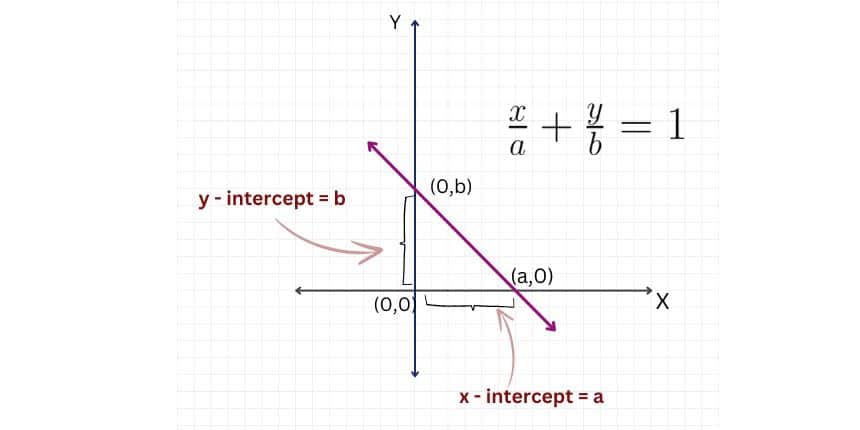
Example: For $x$-intercept as $4$ and $y$-intercept as $5$, the equation of line becomes $\frac{x}{4}+\frac{y}{5}=1$
The normal form of a line
The normal form of a line’s equation involves the perpendicular (normal) distance from the origin to the line. It is given by: $x\cos\alpha + y\sin\alpha=p$
Where $p$ is the length of the perpendicular from the origin to the line, and $\alpha$ is the angle between this perpendicular and the positive $x$-axis.

Example: For $p=5$ and $\alpha=30°$, the equation of the line becomes
$x\cos 30° + y\sin 30° = 5$ ⇒ $\sqrt{3}x+y=10$
Standard form of a line
The standard form of a straight line is given by $ax + by + c = 0$, where $a, b, c$ are real numbers.
Example: The equation of a line in standard form is $2x + 3y + 5 = 0$.
Angle Between Two Straight Lines
The angle($θ$) between two lines with slopes $m_1$ and $m_2$ can be found by using the formula:
$\tan θ = \frac{m_1-m_2}{1+m_1m_2}$
If the value of $\frac{m_1-m_2}{1+m_1m_2}$ is positive, then the angle between the lines is acute.
If the value of $\frac{m_1-m_2}{1+m_1m_2}$ is negative, then the angle between the lines is obtuse.
Distance between Two Points on a Line
The distance between two points on a line $(x_1,y_1)$ and $(x_2,y_2)$ is $d=\sqrt{\left(x_2-x_1\right)^2+\left(y_2-y_1\right)^2}$
Important Formulae for Straight Lines
This section provides all the important formulae for straight lines in one place, including slope, distance, angle, and various forms of line equations.
| Concept | Formula | Description |
|---|---|---|
| General equation of a line | $ax+by+c=0$ | $a,b,c \in \mathbb{R}$, not both $a$ and $b$ zero |
| Slope of a line | $m=-\dfrac{a}{b}$ (from $ax+by+c=0$) | If $b \neq 0$ |
| Slope between two points | $m=\dfrac{y_2-y_1}{x_2-x_1}$ | Provided $x_1 \neq x_2$ |
| Slope-intercept form | $y=mx+c$ | $m$ = slope, $c$ = y-intercept |
| Point-slope form | $y-y_1=m(x-x_1)$ | Line through $(x_1,y_1)$ with slope $m$ |
| Two-point form | $y-y_1=\dfrac{y_2-y_1}{x_2-x_1}(x-x_1)$ | Line through $(x_1,y_1)$ and $(x_2,y_2)$ |
| Intercept form | $\dfrac{x}{a}+\dfrac{y}{b}=1$ | $a,b$ = x- and y-intercepts |
| Normal form | $x\cos\alpha+y\sin\alpha=p$ | $p$ = perpendicular distance from origin, $\alpha$ = angle with x-axis |
| Condition for parallel lines | Slopes equal, $m_1=m_2$ | |
| Condition for perpendicular lines | $m_1 \cdot m_2=-1$ | Product of slopes = $-1$ |
| Equation of line parallel to given line $ax+by+c=0$ through $(x_1,y_1)$ | $ax+by+d=0$ | Use same $a,b$, find $d$ with point substitution |
| Equation of line perpendicular to $ax+by+c=0$ through $(x_1,y_1)$ | $bx-ay+d=0$ | Swap coefficients with sign change |
| Equation of angle bisectors of lines $a_1x+b_1y+c_1=0$, $a_2x+b_2y+c_2=0$ | $\dfrac{a_1x+b_1y+c_1}{\sqrt{a_1^2+b_1^2}}=\pm \dfrac{a_2x+b_2y+c_2}{\sqrt{a_2^2+b_2^2}}$ | Gives both bisectors |
Straight Lines in Mathematics: Solved Previous Year Questions
Question 1:
If $a+2 b+c=0$, then the line $a x+b y+c=0$ always passes through which of the following points:
Answer:
$
\begin{aligned}
& a+2 b+c=0 \Rightarrow c=-a-2 b \\
& \therefore a x+b y+c=0 \\
& \Rightarrow a x+b y-a-2 b=0 \\
& \Rightarrow a(x-1)+b(y-2)=0---(i)
\end{aligned}
$
Comparing it to $\mu L_1+\lambda L_2=0$, this equation represents a family of lines passing through the point of intersection of $x-1=0$ and $y-2=0$, which is $(1,2)$
$\therefore$ All lines of type $a x+b y+c=0$ will pass through $(1,2)$ if $a+2 b+c=0$
Hence, the correct answer is $\left ( 1,2 \right )$.
Question 2:
The equation of the line passing through the point of intersection of lines $\mathrm{y}=\mathrm{x}$ and $x+y+3=0$ and which is parallel to line $2 x+3 y=0$ is:
Answer:
Let the required line be
$
\begin{aligned}
& (x+y+3)+\lambda(y-x)=0 \\
& \Rightarrow(1-\lambda) x+(1+\lambda) y+3=0
\end{aligned}
$
Given that it is parallel to $2 x+3 y=0$
$
\begin{aligned}
& \therefore \text { its slope }=\frac{-2}{3} \\
& \Rightarrow \frac{-(1-\lambda)}{1+\lambda}=\frac{-2}{3} \\
& \Rightarrow 3(1-\lambda)=2(1+\lambda) \\
& \Rightarrow 3-3 \lambda=2+2 \lambda \\
& \Rightarrow 5 \lambda=1 \\
& \Rightarrow \lambda=\frac{1}{5}
\end{aligned}
$
$\therefore$ Line is
$
\begin{aligned}
& \left(1-\frac{1}{5}\right) x+\left(1+\frac{1}{5}\right) y+3=0 \\
& \Rightarrow 4 x+6 y+15=0
\end{aligned}
$
Hence, the correct answer is 4x+6y+15= 0.
Question 3:
The lines $x+2 y-3=0,2 x+y-3=0$, and the line are concurrent. If the line passes through the origin, then its equation is:
Answer:
Intersection point of $x+2 y-3=0$ and $2 x+y-3=0$ is $(1,1)$
$\therefore$ line passes through $(1,1)$ and $(0,0)$
$\therefore$ the equation of a line is
$
\begin{aligned}
& y-0=\frac{1-0}{1-0}(x-0) \\
& \Rightarrow y=x \\
& \Rightarrow x-y=0
\end{aligned}
$
Hence, the correct answer is $x-y=0$.
Question 4:
Equation of the line which is perpendicular to $3 x-4 y+2=0$ and passes through $(2,0)$ is:
Answer:
As the line is perpendicular to $3 x-4 y+2=0$, so let $4 x+3 y+c=0$ be the required line.
Now (2.0) lies on this line, so it should satisfy its equation
$
4(2)+3(0)+c=0 \Rightarrow c=-8
$
$\therefore$ Line is $4 x+3 y-8=0$
Hence, the correct answer is $4 x+3 y-8=0$.
Question 5:
The equation of the bisector of the acute angle between the lines $3 x-4 y+7=0$ and $12 x+5 y-2=0$ is:
Answer:
$
\begin{aligned}
& L_1: 3 x-4 y+7=0 \Rightarrow a_1=3, b_1=-4 \\
& L_2: 12 x+5 y-2=0 \Rightarrow a_2=12, b_2=5
\end{aligned}
$
$
\therefore a_1 a_2+b_1 b_2=36-20=16>0
$
$\therefore$ Acute bisector will be given by the negative sign
$
\begin{aligned}
& \text { Equation } \\
& \frac{3 x-4 y+7}{\sqrt{3^2+4^2}}=\frac{-(12 x+5 y-2)}{\sqrt{12^2+5^2}} \\
& \Rightarrow 13(3 x-4 y+7)=5(-12 x-5 y+2) \\
& \Rightarrow 39 x-52 y+91=-60 x-25 y+10 \\
& \Rightarrow 99 x-27 y+81=0 \\
& \Rightarrow 11 x-3 y+9=0
\end{aligned}
$
Hence, the correct answer is $11x-3y+9= 0$.
List of Topics related to straight lines according to NCERT/JEE Mains
This section outlines the key topics under straight lines, as per the NCERT and JEE Main syllabus. These topics will help you gain better conceptual clarity.
Straight Lines in Different Exams
The chapter Straight Lines is a fundamental part of coordinate geometry that deals with representing and analysing lines on a plane using algebraic equations. It is an important topic in Class 11 Mathematics and is frequently tested in board as well as competitive examinations. Questions from this chapter assess a student’s understanding of slopes, different forms of equations of a line, and the geometric interpretation of results. Regular practice of NCERT problems and a clear understanding of formulas help students master this chapter and score well in exams.
| Exam Name | Focus Area | Common Topics Asked | Preparation Tips |
|---|---|---|---|
| CBSE Board | Conceptual clarity & formula use | Slope, various forms of line equations, and distance between points | Learn formulas thoroughly and practise NCERT examples |
| JEE Main | Accuracy & coordinate geometry | Angle between lines, pair of straight lines, point–line distance | Practise MCQs and numerical-based questions regularly |
| JEE Advanced | Analytical and geometric reasoning | Combined line problems, locus-based questions | Solve advanced-level and previous years’ questions |
| NEET | Basics & direct application | Standard forms of straight lines, simple distance problems | Focus on the quick application of formulas |
| State Board Exams (ICSE, UP Board, RBSE, etc) | Theory-oriented | Definitions, derivations, textbook-based problems | Revise theory and practice solved examples |
| Mathematics Olympiads | Conceptual depth | Challenging geometric and coordinate-based problems | Strengthen fundamentals and practise higher-level questions |
Important Books and Resources for Straight Lines
Here you will find recommended books and resources that explain straight-line concepts, equations, and problem-solving techniques with clarity.
| Book Title | Author / Publisher | Description |
|---|---|---|
| NCERT Mathematics Class 11 | NCERT | Official textbook with thorough coverage of the straight lines topic. |
| Mathematics for Class 11 | R.D. Sharma | Clear explanations and extensive solved examples on straight lines. |
| Objective Mathematics | R.S. Aggarwal | Comprehensive MCQs and practice problems on straight lines. |
| Arihant All-In-One Mathematics | Arihant | Complete topic-wise coverage, including straight lines. |
| Coordinate Geometry | S.L. Loney | Classic book with challenging problems on straight lines. |
NCERT Resources for Straight Lines
This section highlights the NCERT textbook chapters that introduce straight lines and build conceptual understanding for Class 11 and competitive exams.
NCERT Subjectwise Resources
This section provides NCERT exemplar solutions, detailed notes, and step-by-step solutions to strengthen your preparation.
| Subject | NCERT Notes Link | NCERT Solutions Link | NCERT Exemplar Link |
|---|---|---|---|
| Mathematics | NCERT Notes Class 11 Maths | NCERT Solutions for Class 11 Mathematics | NCERT Exemplar Class 11 Maths |
| Physics | NCERT Notes Class 11 Physics | NCERT Solutions for Class 11 Physics | NCERT Exemplar Class 11 Physics |
| Chemistry | NCERT Notes Class 11 Chemistry | NCERT Solutions for Class 11 Chemistry | NCERT Exemplar Class 11 Chemistry |
Practice Questions based on Straight Lines
Here you will get a collection of practice problems to apply straight line formulas, improve accuracy, and boost exam readiness.
Conclusion
The chapter Straight Lines lays a strong foundation for coordinate geometry by helping students understand linear relationships and their graphical representation. By mastering concepts such as slope, equations of a line in different forms, and conditions for parallel and perpendicular lines, students develop clarity and confidence in solving geometric problems. This chapter is essential for Class 11 Mathematics and plays a crucial role in higher-level topics and competitive exams like JEE. With regular practice of NCERT problems and a clear understanding of formulas, students can easily score well and apply these concepts to real-life situations.
Frequently Asked Questions (FAQs)
The general equation of a straight line in a plane is $ax + by + c = 0$, where $a$, $b$, and $c$ are real constants and not both $a$ and $b$ are zero.
The slope of a line represents its steepness and is given by $m = \frac{y_2 - y_1}{x_2 - x_1}$ if two points on the line are $(x_1, y_1)$ and $(x_2, y_2)$.
The main forms are:
Slope-intercept form: $y = mx + c$
Point-slope form: $y - y_1 = m(x - x_1)$
Two-point form: $y - y_1 = \frac{y_2 - y_1}{x_2 - x_1}(x - x_1)$
Intercept form: $\frac{x}{a} + \frac{y}{b} = 1$
General form: $ax + by + c = 0$
Two lines are parallel if their slopes are equal ($m_1 = m_2$).
Two lines are perpendicular if the product of their slopes is $-1$ ($m_1 \cdot m_2 = -1$).
The slope of a straight line can be calculated using the formulas,
- The slope of a line with given two points $(x_1,y_1)$ and $(x_2,y_2)$ is $m = \frac{y_2-y_1}{x_2-x_1}$
- The slope of a line with a given angle $\theta$ is $ m = \tan \theta $
- The slope of a line from the equation of the line of the form $y=mx+c$ is the coefficient of the variable $x$, which is $m$.
